Business Insights
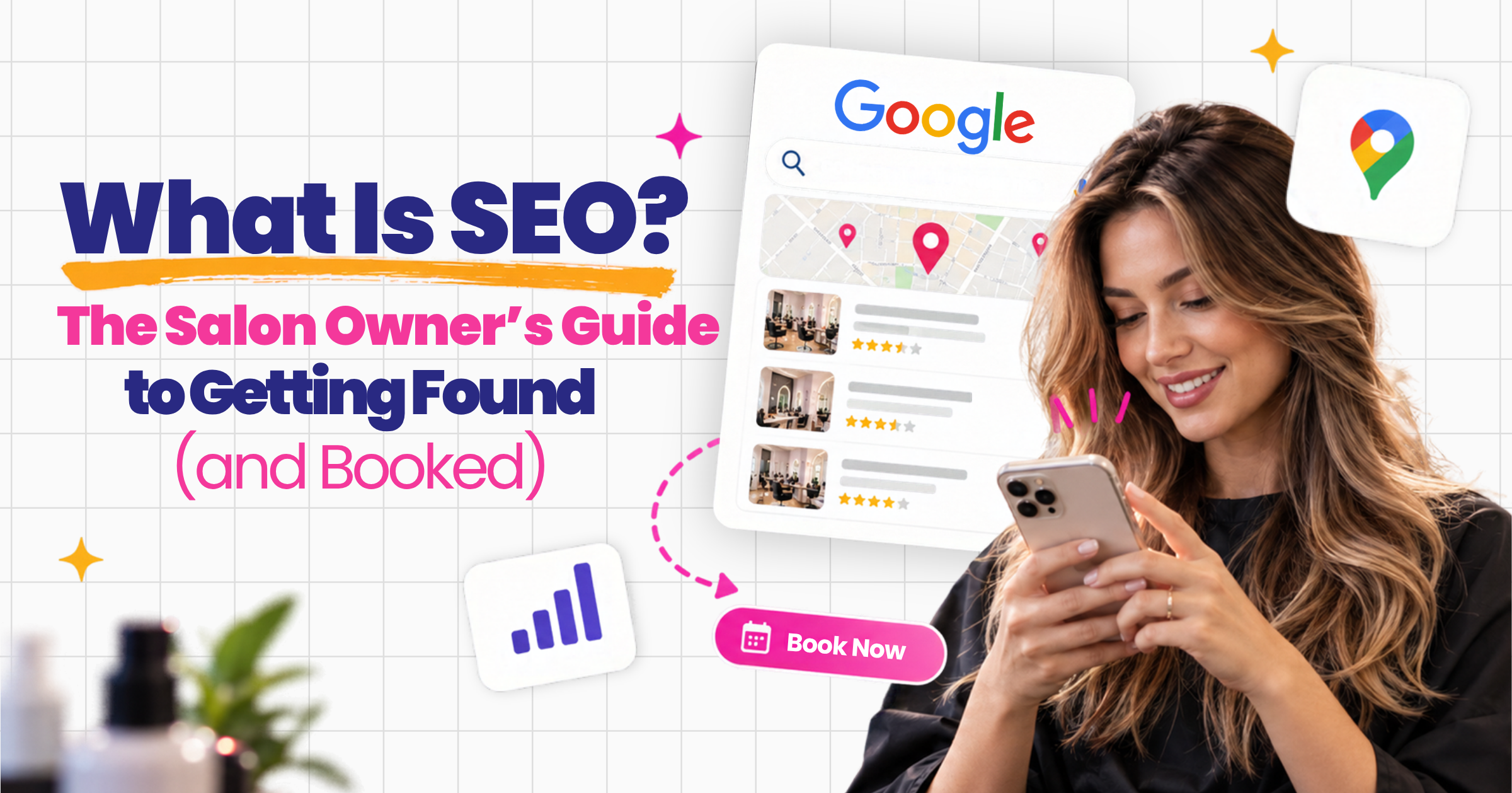
What Is SEO? The Salon Owner’s Guide to Getting Found (and Booked)

It's 9:40 on a Tuesday night. Somewhere in your city, a woman is staring at a box dye job gone brassy orange. She's typing "color correction near me" with one hand and holding her hair up to the bathroom light…
It’s 9:40 on a Tuesday night. Somewhere in your city, a woman is staring at a box dye job gone brassy orange. She’s typing “color correction near me” with one hand and holding her hair up to the bathroom light with the other.
She isn’t waiting for a referral. She’s booking whoever looks legit on the first screen of Google, and she’s doing it before bed.
Will your salon show up when she searches? That’s where SEO comes in.
So, what is SEO? Search engine optimization is everything you do to help Google (and now AI tools like ChatGPT) find your salon, understand your services, and put you in front of clients who are ready to book.
Great work behind the chair fills your book through referrals. Great SEO fills the gaps referrals can’t reach. Here’s the no-jargon version, written for owners who’d rather be foiling than Googling.
What Is SEO, and Why Does It Matter for Salons?
SEO (Search Engine Optimization) is the process of helping your salon show up when potential clients search Google, Apple Maps, or AI tools like ChatGPT for the services you offer. For most salons, that means ranking in the local map results for searches like “balayage near me.”
Why does that matter? Most salon marketing works like handing out flyers. Your Instagram post lands between baby pics and cat videos, and your promo email sits next to the phone bill. You’re reaching people when hair is the last thing on their mind.
SEO flips that. Every day in your city, people search “curly cut specialist Austin,” “bridal hair trial Gilbert,” or “how much are tape-in extensions.” Each one is a potential client with a need, a budget, and often a date already circled on the calendar.
And unlike ads marked “Sponsored,” organic rankings don’t vanish the minute your budget runs dry. Strong SEO can keep bringing potential clients your way month after month, although maintaining your visibility takes ongoing work.
How Does Google Decide Which Salons Show Up First?
Google ranks salons in local results using three main factors: relevance, distance, and prominence. These factors help determine which businesses appear in the map pack, a prominent section of local search results that typically features three businesses, along with details like ratings, hours, and directions.
Those three factors aren’t so different from how a new client picks a stylist:
- Relevance: Do you actually offer what they searched for? If your website and Google profile never mention extensions, you won’t show up for “hair extensions near me,” the same way nobody books a barber for a sew-in.
- Distance: How close is your salon to the person searching? Someone looking for a quick bang trim may prefer a nearby salon over one that’s 40 minutes away.
- Prominence: How known and trusted is your salon? Google looks at reviews, links, and mentions across the web. Think of it as online word of mouth.
You can’t control how close your salon is to every potential client, but you can improve your relevance and build your salon’s online reputation.
What Are the Four Types of SEO for Salons?
The four types of SEO are local, on-page, technical, and off-page. Think of them like your salon team: each one has its own job, and when one drops the ball, the whole day feels it.
| Type of SEO | Think of it as | What it covers | Salon example |
|---|---|---|---|
| Local SEO | Your front desk | Google Business Profile, directory listings, and the same name, address, and phone number everywhere | An outdated suite number on Yelp sending potential clients to the wrong location. |
| On-page SEO | Your service menu | Service pages, city mentions, headings, and answers to consultation questions | A silk press page covering who it suits, appointment length, and price range |
| Technical SEO | Your plumbing | Site speed, mobile layout, and whether Google can read every page | A slow website or hard-to-find “Book Now” button costing your salon potential bookings |
| Off-page SEO | Your reputation around town | Reviews, links from other sites, local press, and brand and salon locators | A local bridal blog feature that links back to your site |
For most salons, local SEO does the heavy lifting. It helps improve your chances of appearing in the map pack when potential clients search for nearby services.
Do Google Reviews Help a Salon’s SEO?
Yes. Reviews count toward prominence, one of Google’s three local ranking factors, and they’re often what tips a client toward your salon over the other two in the map pack.
The bar keeps climbing. BrightLocal’s 2026 Local Consumer Review Survey of 1,002 US adults found that 97% of consumers read reviews when choosing a local business. It also found that 68% now want at least a 4-star rating before they’ll consider one, up from 55% a year earlier.
Fresh reviews also help potential clients see what it’s like to visit your salon today, rather than relying entirely on feedback from years ago.
So treat reviews as a habit, not a campaign. Send a same-day text with a direct link to your Google review page, right alongside your rebooking reminder, while they’re still admiring their fresh new hairstyle. Then reply to every review, even the three-star one about parking.
How Do ChatGPT and Other AI Tools Recommend Salons?
AI tools like ChatGPT, Gemini, and Google’s AI Mode can use information from salon websites and other online sources to recommend businesses. Keeping your website detailed and your business information consistent across relevant platforms gives these tools more accurate information to work with.
This is no longer a fringe habit. The same BrightLocal survey found that the share of consumers using AI tools for local business recommendations jumped from 6% to 45% in one year, while the share using Google for reviews and recommendations dropped from 83% to 71%.
Picture a client asking ChatGPT, “Who’s the best blonde specialist in Scottsdale?” A salon with a detailed blonding page, matching listings, and reviews that rave about its toning gives the AI plenty to work with.
Marketers call this answer engine optimization (AEO) or generative engine optimization (GEO), but for a salon owner, it’s simply SEO done thoroughly.
What SEO Mistakes Do Salons Make Most Often?
The most common salon SEO mistakes are thin service pages, leaning on Instagram alone, and a Google Business Profile nobody updates. Some are quick to address, while others take a little more planning.
Between working behind the chair, managing your team, handling no-shows, and keeping up with inventory, SEO can easily slide to the bottom of your list. Here are some of the mistakes we see most often:
- One page for all your services. A single “Services” page with a price list is a menu, not a strategy. Give your money-makers, like color, extensions, and bridal, their own pages so each one can rank.
- Treating Instagram like your website. Your grid might be stunning, but Google rarely ranks Instagram posts for “balayage near me.” Your website and Google profile carry that weight.
- Never saying where you are. If your site doesn’t mention your city or neighborhood, Google has to guess. Work it naturally into page titles, headings, and copy.
- A dusty Google Business Profile. Last year’s holiday hours, missing services, and the same five photos from opening week tell Google nobody’s minding the listing.
- A website that’s only a booking widget. Sending everyone straight to your booking software skips the part where you sell the experience. Clients and Google both need to know what makes your salon worth the drive.
- Stock photos of models who’ve never sat in your chair. Real photos of your team, your space, and your before-and-afters build trust and give Google original content.
How Long Does SEO Take for a Salon?
Some salons may see early improvements within a few weeks, while stronger results can take several months, depending on how competitive their market is. Changes like updating your Google Business Profile are a good place to start, but SEO takes consistent effort.
Remember building your book when you first started? Nobody goes from an empty chair to fully booked in a week. SEO grows the same way.
The payoff can be worth the wait. Unlike paid ads, organic rankings don’t cost you per click, and a strong service page can continue attracting potential clients long after it’s published.
How Can Salon Owners Start Improving SEO Today?
Start with your Google Business Profile. Update your hours, list every service on your menu, and add fresh photos of your space and your work. It’s usually the quickest SEO win a salon has.
Next, check that your salon name, address, and phone number match exactly on your website, Google, Yelp, Apple Maps, and your booking platform. Then add a review request to checkout this week. While you’re at it, make sure your homepage says what you do and where you do it within the first few lines.
The bigger projects, like writing service pages, speeding up your site, earning links, and tracking rankings, take steady hours most owners don’t have between clients. That’s where the salon-savvy team at Spark Pro Global comes in to handle marketing and tech support for you, so your salon can keep growing online while you stay focused on the chair.
So, what is SEO? It’s helping the next client with a 9:40 p.m. color correction emergency find your salon and book an appointment.
Frequently Asked Questions About SEO for Salons
Is SEO worth it for a small salon or booth renter?
Yes, especially for booth renters and small salons that can’t outspend bigger competitors on ads. Local SEO helps you compete through relevance and reputation rather than advertising budget alone. If you’re a booth renter, check whether you qualify for your own Google Business Profile. A strong online presence and helpful service pages can make it easier for potential clients to discover your services without paying for every click.
Can I do SEO for my salon myself?
You can handle the basics yourself: updating your Google Business Profile, asking for reviews, and keeping your contact details consistent. The harder parts, like writing optimized service pages, fixing site speed, and tracking rankings, take hours most owners don’t have. Many salons do the basics in-house and outsource the rest.
What’s the difference between SEO and Google Ads for salons?
Google Ads can put your salon in prominent positions in search results, but you typically pay for each click, and your ads stop appearing when you pause your campaign. SEO takes time to build, but strong organic visibility can continue attracting potential clients without a cost per click. Many salons use ads for launches and SEO for long-term visibility.
Does Instagram help my salon’s SEO?
Not directly. Google rarely ranks Instagram posts for local searches like “lash lift near me,” and social signals aren’t a confirmed ranking factor. Instagram still helps indirectly: it builds brand searches, keeps clients engaged, and gives AI tools more mentions of your salon. Link it to your website and Google Business Profile.
Do I need a website if I have a Google Business Profile and a booking app?
Yes. Your Google Business Profile helps you appear in the map pack, but a website gives Google and AI tools the detail they need to rank you for specific services. Pages for balayage, extensions, or bridal hair answer client questions your booking app can’t, and they build trust before anyone books.